
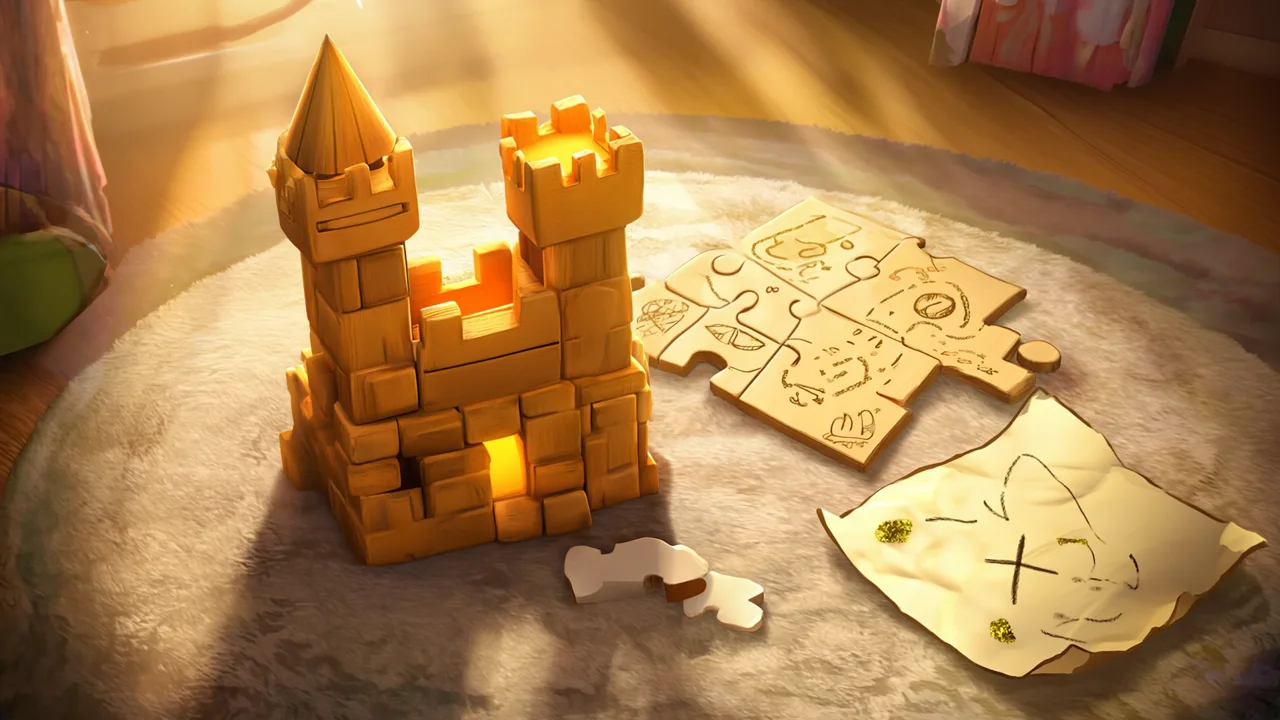
Spatial thinking means picturing shapes, understanding where things are in relation to each other, and imagining how they might be turned, flipped or fitted together. It’s used in maths, science, reading maps and everyday problem solving.
Early years guidance in England notes the importance of rich opportunities for children to develop spatial reasoning across shape, space and measures.
What the research shows
These are associations rather than proof that one causes the other, but they point to playful, low-cost activities worth doing anyway.
- Puzzles: in one study, children who played with puzzles more often between ages two and four did better on a spatial task at four and a half, even after accounting for family background.
- Blocks: three-year-olds who were better at copying block models also tended to have stronger early maths skills.
- Spatial words: children who heard more words like “corner”, “side” and “tall” used more of them themselves and did better on spatial problems.
Everyday ways to build spatial thinking
- Build together and copy each other’s small block models.
- Do jigsaws, talking about edges, corners and turning pieces.
- Use position words: on top of, under, behind, next to, through.
- Go on shape hunts: circles on a bike, rectangles in windows.
- Draw a simple map of the bedroom or the route to the shop.
- Play hide and seek with clues: “It’s behind something soft.”
Talk about shape properties
Beyond naming “triangle”, help your child notice why it is one: three straight sides, three corners. Development Matters encourages informal words like “pointy”, “curvy” and “sharp corner” when talking about shape properties.
Keep it open-ended
Free building is as valuable as following instructions. Let your child experiment, topple and rebuild. In Kvasi, Nidavellir, the realm of the dwarf smiths, uses building and shape puzzles in the same spirit, but a box of blocks on the floor does the job beautifully.